Skip to content
Magulan Group

Services

Production.

Ten steps that decide dimensional accuracy and surface: this is how precast concrete is produced that can be built in.

Anyone planning a precast plant must know production. Magulan brings practice from the line: formwork, reinforcement, concrete, curing, demoulding, finishing, inspection, transport.

Every step decides tolerance, surface and cycle. That is why we do not write the sequence as a catalogue, but as the sequence a line must carry in daily operation.

That is the benchmark for engineering: a plant that masters exactly these steps — precisely, repeatably, with as little labour and energy as the process allows.
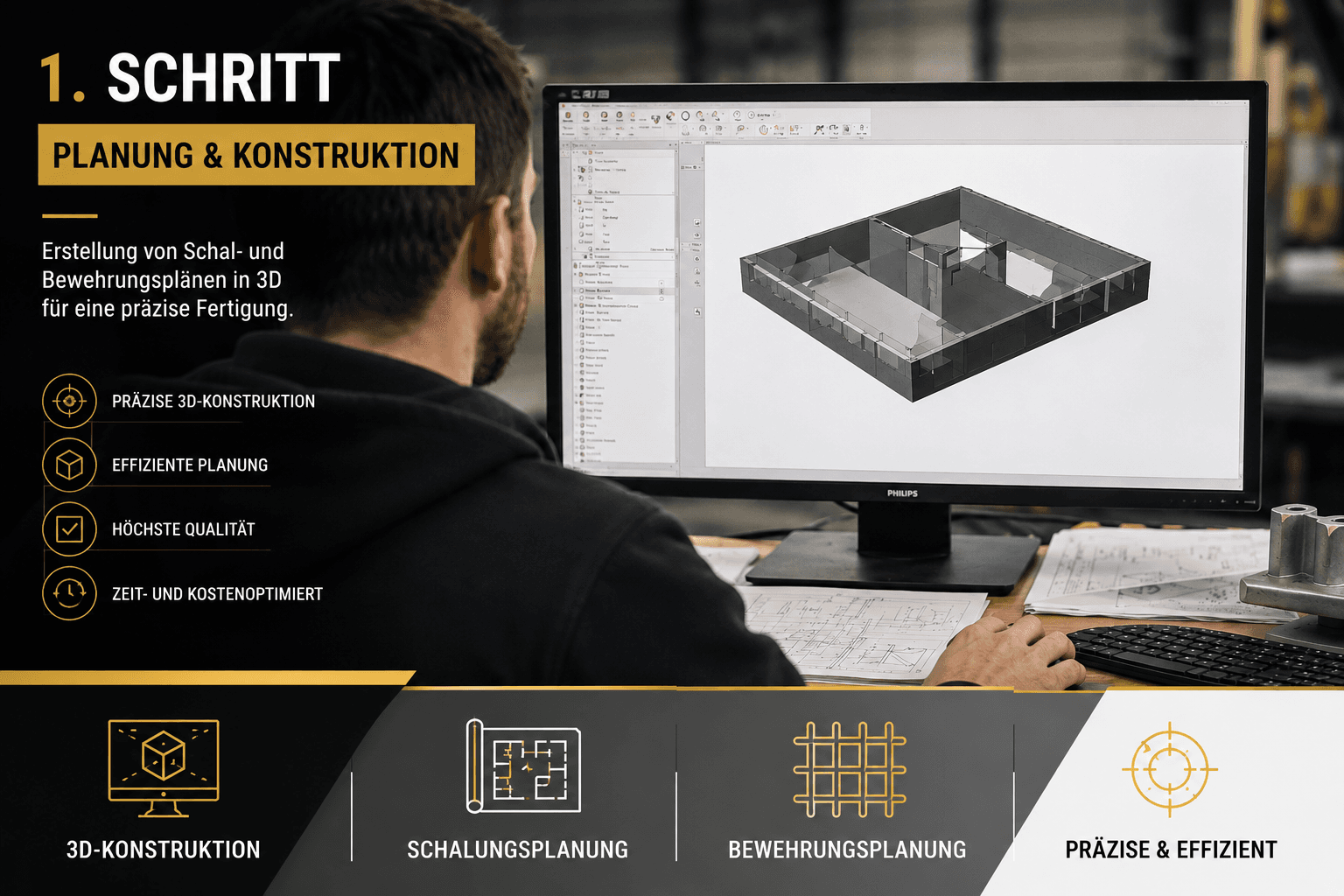
  1. 3D design of formwork and reinforcement on screen

    01

    Planning & design

    Formwork and reinforcement drawings are produced in 3D — for production that fits before the first pallet enters the hall. Design, formwork and reinforcement interlock, not follow one another.

    • Precise 3D design instead of later adjustment
    • Formwork and reinforcement planning in one model
    • Time and cost on the drawing, not on the floor
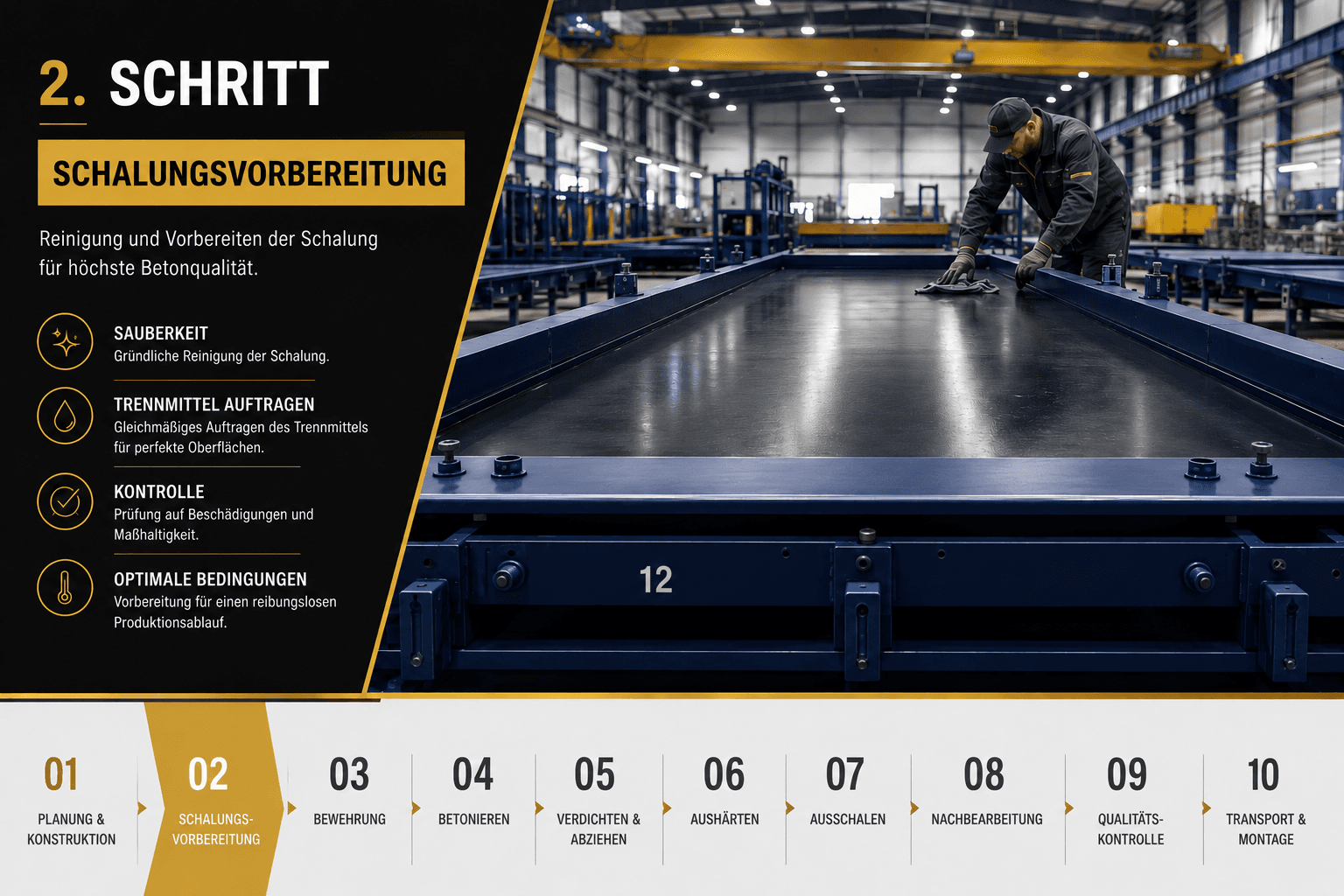
  2. Preparation of the steel formwork in the production hall

    02

    Formwork preparation

    Clean formwork, even release agent, verified dimensional accuracy. The surface of the precast element is decided here — not only at demoulding.

    • Thorough cleaning of every mould
    • Release agent for even fair-faced surfaces
    • Check for damage and dimension before reinforcing
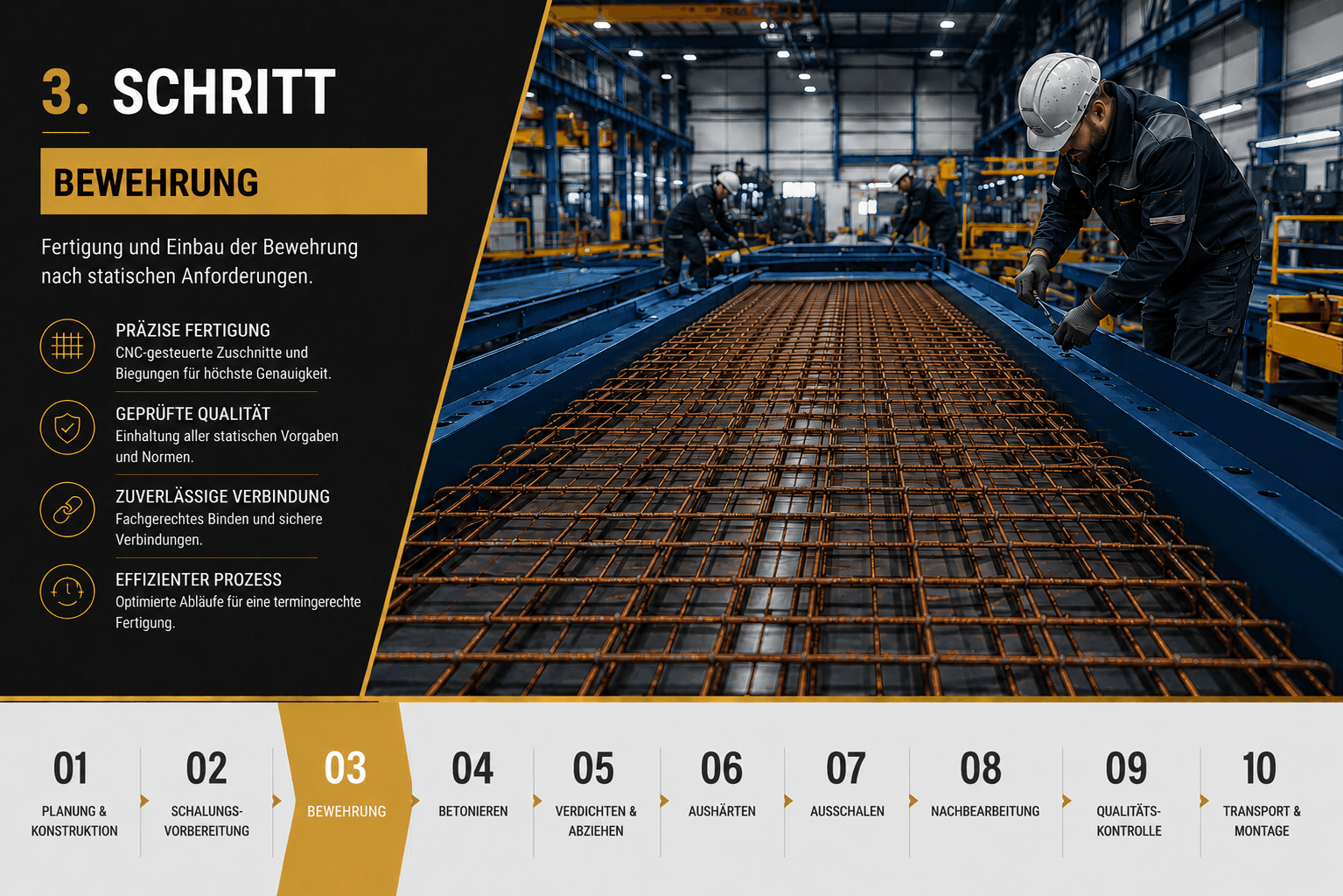
  3. Reinforcement cage in a steel mould, a specialist aligning the steel

    03

    Reinforcement

    Cutting and bending to the structural design, CNC-guided where accuracy requires it. Placing, tying and connecting so that the cage sits in the formwork as calculated — on time, without rework on pouring day.

    • CNC cutting and bending to structural specification
    • Connections to standard and verified position
    • A sequence that holds the concreting rhythm
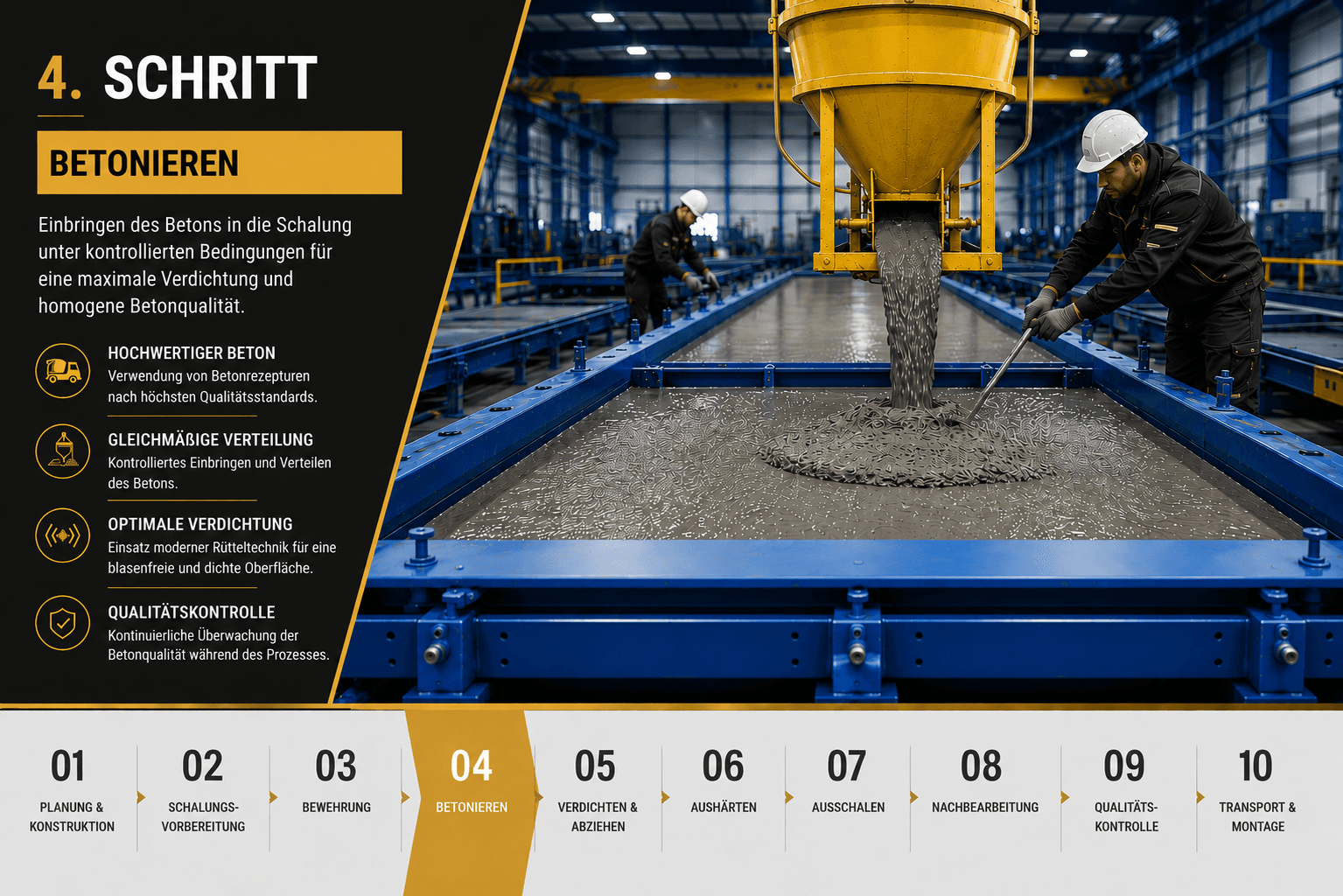
  4. Fresh concrete being placed into a long steel mould

    04

    Concreting

    Mix design to requirement, placing under control, distribution without honeycombing. Concrete quality is monitored during placing — not only on the cube after three days.

    • Concrete mix designs to a defined standard
    • Controlled placing and distribution
    • Ongoing monitoring of consistency and quality
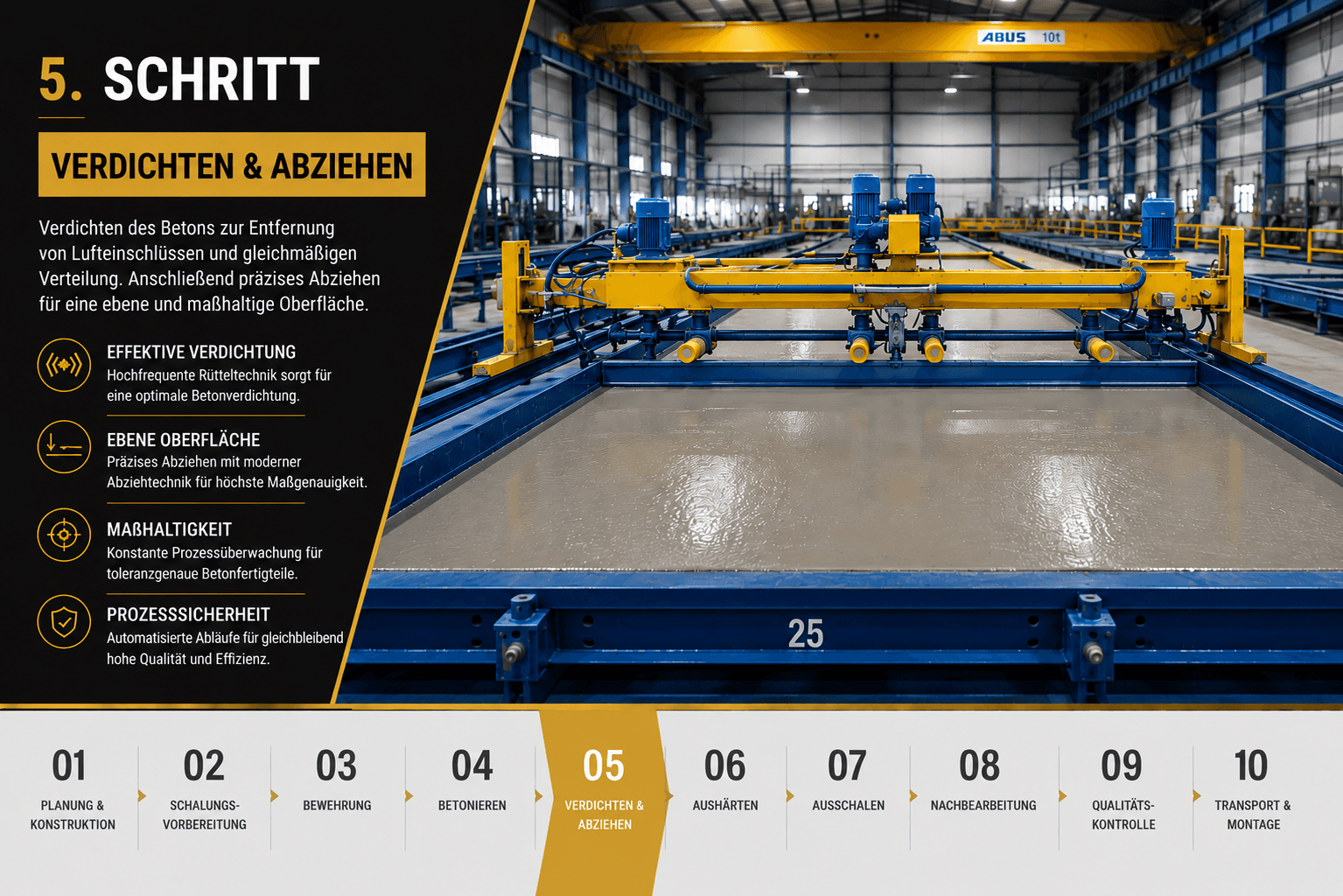
  5. Compacting and screeding fresh concrete on the casting table

    05

    Compaction & screeding

    High-frequency vibration drives air out of the mix. Then screeding: level, dimensionally accurate, repeatable. What remains imprecise here cannot be ground away later.

    • Compaction for a dense, low-void structure
    • Screeding to a level, tolerance-accurate surface
    • Process monitoring instead of rework
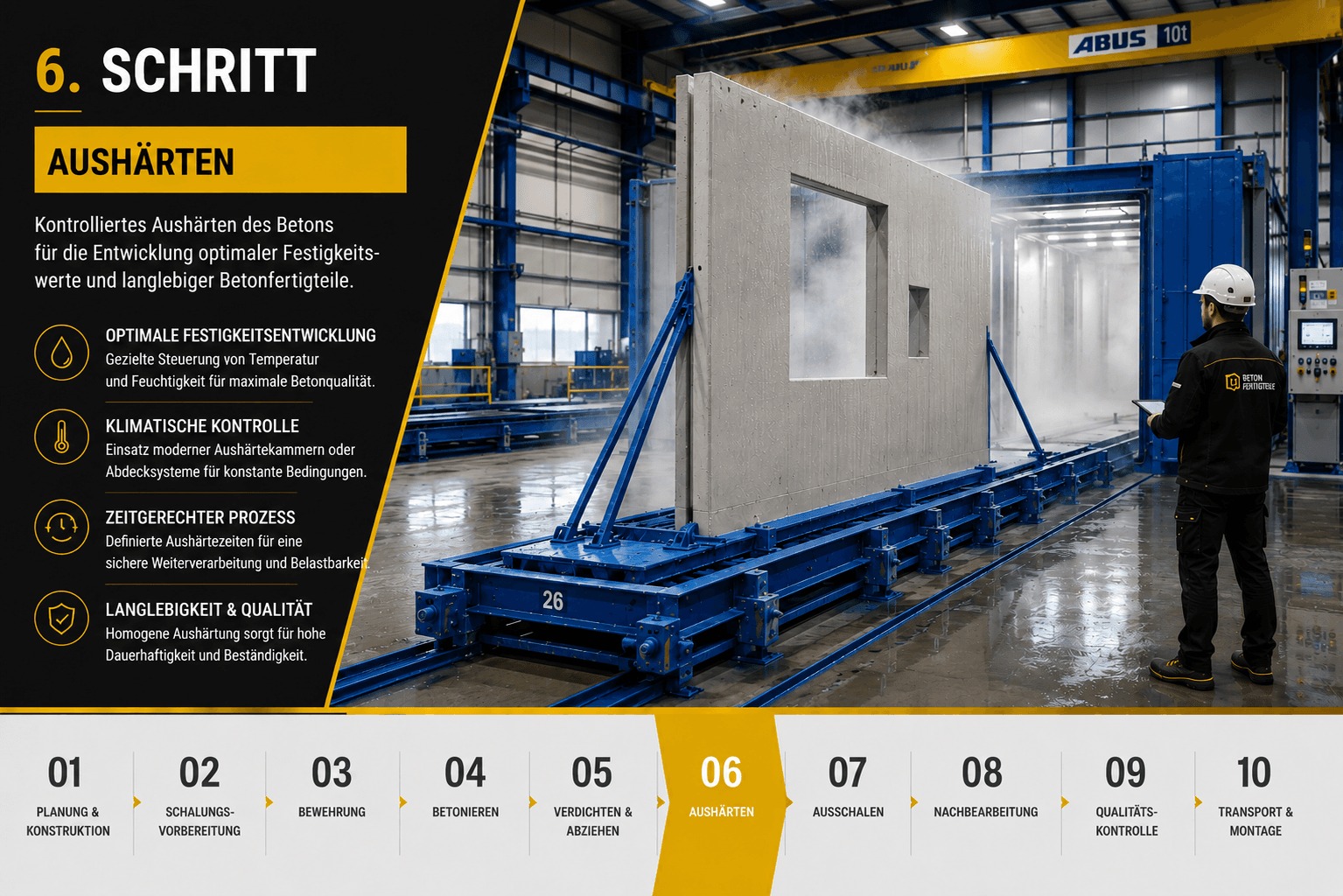
  6. Curing of a wall element under controlled temperature and humidity

    06

    Curing

    Temperature and humidity govern strength development. Chambers or covering hold the climate; defined times secure further processing. Homogeneous curing is durability, not waiting time.

    • Targeted control of temperature and humidity
    • Defined curing times before demoulding
    • Uniform maturity for load-bearing precast elements
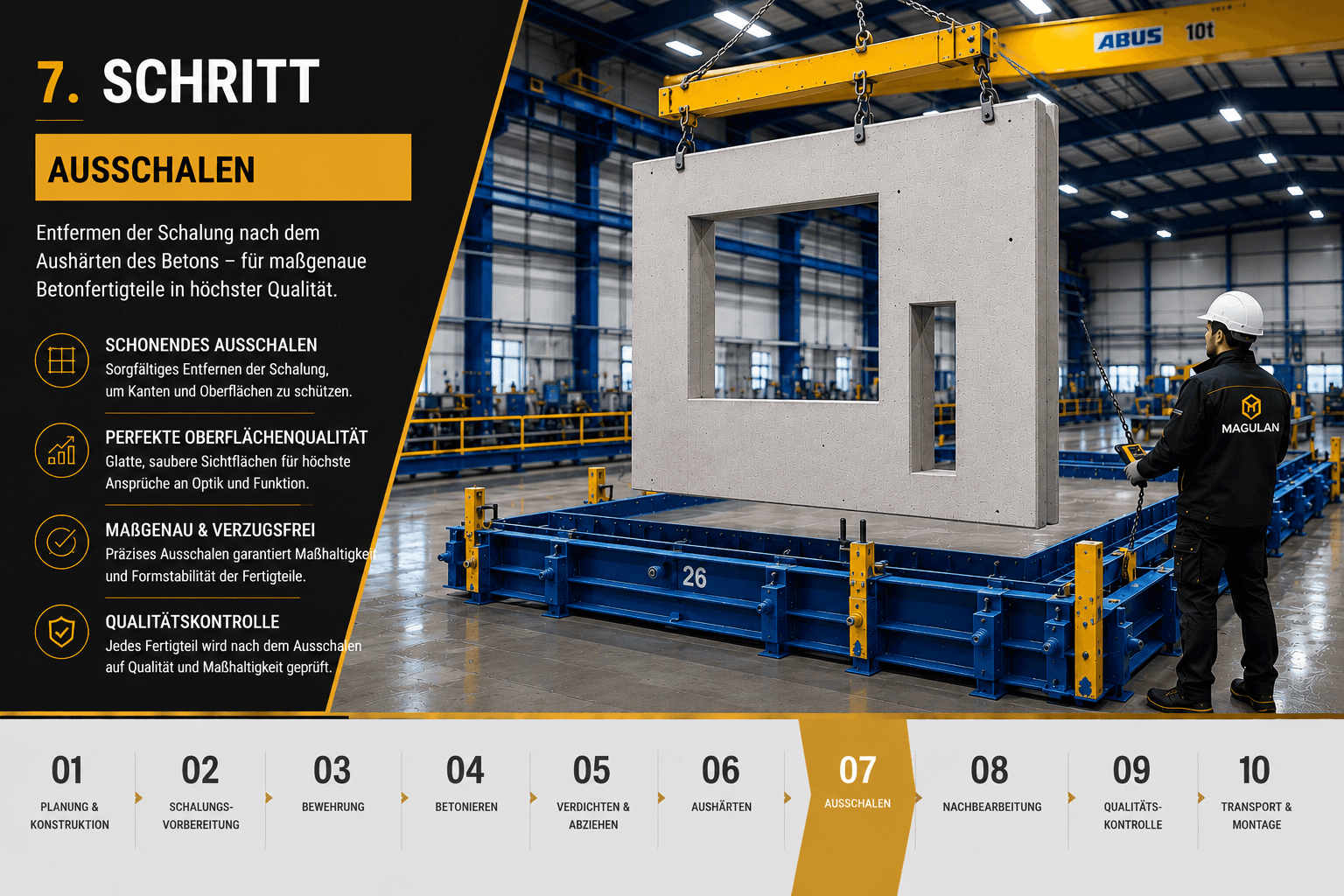
  7. Wall precast with window openings being lifted from the mould by hall crane

    07

    Demoulding

    The formwork is released gently from the element; edges and fair faces remain. What the mould held, the precast element must now hold itself — dimensionally accurate, free of warping, inspected before it moves on.

    • Gentle release to protect edge and face
    • Smooth fair faces without breakouts
    • Immediate check of dimension and shape
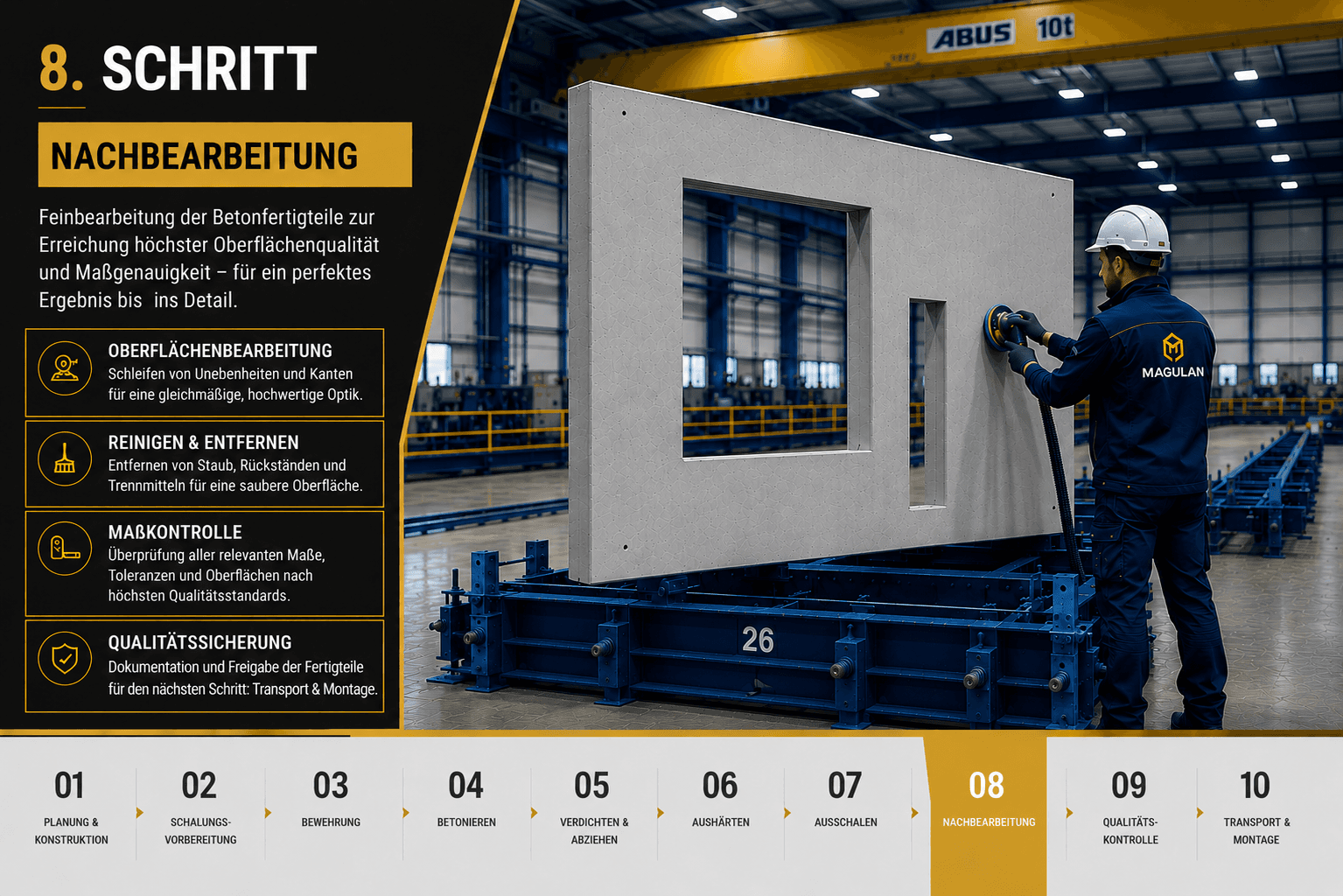
  8. Finishing of the precast surface in the hall

    08

    Finishing

    Grinding, edging, cleaning: the last layer before release. Unevenness, release-agent residue and tolerances are closed before the unit goes to quality control.

    • Surfaces and edges to a consistent appearance
    • Removal of dust, burr and release agent
    • Dimensional check before release for dispatch
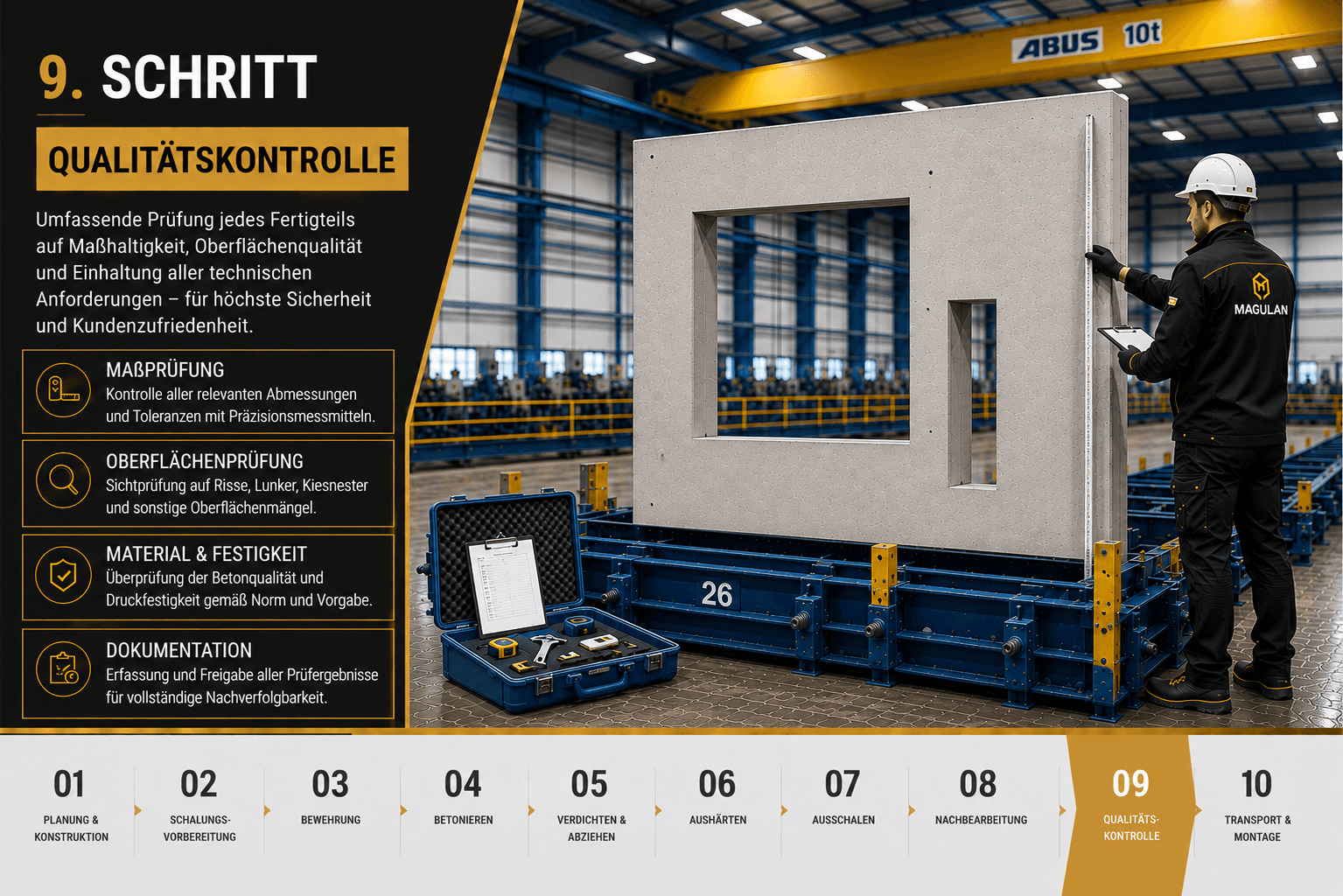
  9. Dimensional and visual inspection of a precast element before release

    09

    Quality control

    Every precast element is inspected for dimension, surface and strength. Cracks, voids, honeycombing, deviations: recorded, assessed, documented. No transport without release.

    • Dimension and tolerance with suitable measuring equipment
    • Visual inspection for cracks, voids and honeycombing
    • Concrete quality and complete inspection documentation
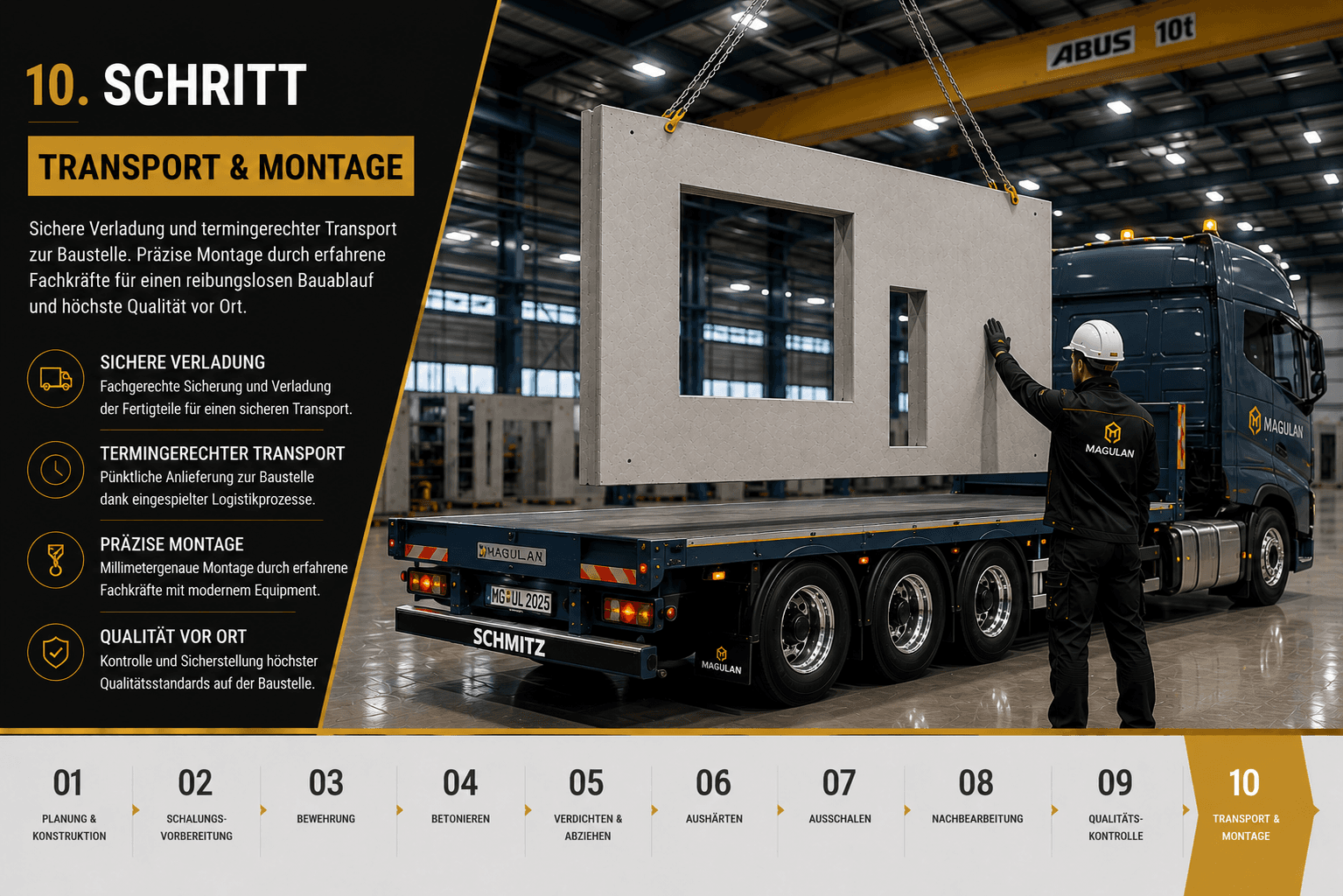
  10. Wall precast being loaded onto an articulated lorry by hall crane

    10

    Transport & installation

    Secure, load, deliver to site on time. On site the crew sets the element to the millimetre. The quality of the line must arrive on site — not only in the works protocol.

    • Proper load securing of the precast elements
    • Delivery in the rhythm of the site
    • Precise installation and inspection on site

Production that carries the engineering.

Those who know the steps of production plan plants that run in daily operation. That is exactly what we connect.

Arrange a meeting